53 sizes in this line. Pick the one printed on the sidewall of the tires on your truck now.
On the sidewall. A string like LT285/70R17, molded into the side of the tires on your truck now.
In the door jamb. Open the driver door and read the sticker on the frame — it lists the size the truck left the factory on.
Still not sure? Call 800-953-7108 and we will read it off your VIN.
Enter the size on your truck today and every row below tells you how much taller or shorter it stands, and what your speedometer will read.
Not sure what size you need? Call your store and we will work it out for your truck — 800-953-7108
No size matches that. Clear the filters to see all 53 sizes, or call 800-953-7108 and we will look it up for you.
The code on the sidewall tells you everything the chart above is sorted by. Here is how to read it.
Reading P235/75R15 — type a size in either box above and this follows it
That is not a size we can read. Sizes look like LT285/70R17 or 35X12.50R20.
Molded into the side of the tires on the truck now, in letters about a quarter-inch tall. It reads something like LT285/70R17, usually with the load index and speed rating right after it.
Open the driver door and read the sticker on the frame. It lists the size the truck left the factory on and the pressures it was set up for. If somebody has already changed sizes, the sidewall is the truth and this sticker is the history.
Still not sure? Call 800-953-7108 with your VIN and we will read it off for you.
What does the load index on a tire mean?
The number straight after the size is the load index — a code for the most weight one tire can carry at its rated pressure. Multiply by four for the axle-pair total the truck can sit on.
Light-truck tires print two, like 121/118. The first is what it carries on a single-wheel axle; the second is the lower figure it is derated to on a dual-rear-wheel truck, where the pair runs hotter and shares an uneven load. On a dually, the second number is the one that counts.
| Index | Per tire | Index | Per tire | Index | Per tire |
|---|---|---|---|---|---|
| 75 | 853 lb | 94 | 1,477 lb | 113 | 2,535 lb |
| 76 | 882 lb | 95 | 1,521 lb | 114 | 2,601 lb |
| 77 | 908 lb | 96 | 1,565 lb | 115 | 2,679 lb |
| 78 | 937 lb | 97 | 1,609 lb | 116 | 2,756 lb |
| 79 | 963 lb | 98 | 1,653 lb | 117 | 2,833 lb |
| 80 | 992 lb | 99 | 1,709 lb | 118 | 2,910 lb |
| 81 | 1,019 lb | 100 | 1,764 lb | 119 | 2,998 lb |
| 82 | 1,047 lb | 101 | 1,819 lb | 120 | 3,086 lb |
| 83 | 1,074 lb | 102 | 1,874 lb | 121 | 3,197 lb |
| 84 | 1,102 lb | 103 | 1,929 lb | 122 | 3,307 lb |
| 85 | 1,135 lb | 104 | 1,984 lb | 123 | 3,417 lb |
| 86 | 1,168 lb | 105 | 2,039 lb | 124 | 3,527 lb |
| 87 | 1,201 lb | 106 | 2,094 lb | 125 | 3,638 lb |
| 88 | 1,235 lb | 107 | 2,149 lb | 126 | 3,748 lb |
| 89 | 1,279 lb | 108 | 2,205 lb | 127 | 3,858 lb |
| 90 | 1,323 lb | 109 | 2,271 lb | 128 | 3,968 lb |
| 91 | 1,356 lb | 110 | 2,337 lb | 129 | 4,079 lb |
| 92 | 1,389 lb | 111 | 2,403 lb | 130 | 4,189 lb |
| 93 | 1,433 lb | 112 | 2,469 lb |
What does the speed rating letter on a tire mean?
The letter after the load index is the speed rating: the highest speed the tire is built to sustain while carrying its rated load. It is an engineering limit, not a suggestion, and it is not a promise about anything else the truck does.
Fitting a lower rating than the truck came with is legal and common on an off-road tire — a mud terrain in Q is normal — but it is worth knowing you have done it.
| Symbol | Rated to | Symbol | Rated to |
|---|---|---|---|
| F | 50 mph | R | 106 mph |
| G | 56 mph | S | 112 mph |
| J | 62 mph | T | 118 mph |
| K | 68 mph | U | 124 mph |
| L | 75 mph | H | 130 mph |
| M | 81 mph | V | 149 mph |
| N | 87 mph | W | 168 mph |
| P | 93 mph | Y | 186 mph |
| Q | 99 mph |
What does load range E mean on a tire?
A load range letter is how much air the casing is built to hold, and therefore how much it can carry. The ply number beside it is historical: a load range E tire has not been made of ten plies of cotton since the 1960s, but the rating is still quoted against that number.
Heavier is not automatically better. An E-rated tire on a half-ton rides harder and costs more than the C or D the truck was designed around, and carries weight it will never be asked to carry.
The maximum pressure depends on how wide the tire is, which is the part almost nobody prints. A casing wider than 295mm (11.5") is rated one step down — a load range E in a 285 is an 80 psi tire, and a load range E in a 35x12.50 is a 65 psi tire. Both are E.
| Range | Ply rating | Max pressure up to 11.5" wide | Over 11.5" wide | What it is for |
|---|---|---|---|---|
| SL | 4-ply rated | 35 psi | — | Standard load — a passenger-car rating. |
| XL | 4-ply rated | 41 psi | — | Extra load — a passenger casing rated to carry more at higher pressure. |
| B | 4-ply rated | 35 psi | — | Light-duty light-truck rating. |
| C | 6-ply rated | 50 psi | 35 psi | Light-truck, 6-ply rated. |
| D | 8-ply rated | 65 psi | 50 psi | Light-truck, 8-ply rated. |
| E | 10-ply rated | 80 psi | 65 psi | Light-truck, 10-ply rated — the usual choice for a 3/4- or 1-ton truck. |
| F | 12-ply rated | 95 psi | 80 psi | Light-truck, 12-ply rated — heavy hauling and dual-rear-wheel work. |
| G | 14-ply rated | 110 psi | 95 psi | Light-truck, 14-ply rated. |
Whatever the sidewall says, the pressure to actually run is the one on the sticker in your driver door jamb — that figure is set for your truck, not for the tire.
How much bigger can I go without a lift?
The figure that matters is overall height, not the number on the sidewall. Two sizes written completely differently can stand within a quarter of an inch of each other, and two that look similar can be two inches apart.
Stay within about 3% of the height you run now and the speedometer, the odometer, the transmission shift points and the ABS all stay honest, and nothing needs recalibrating. Go past that and the speedometer reads low — you are going faster than it says — and on a lot of trucks the tire starts finding the firewall or the sway bar at full lock.
Use the Compare to what you run now box above the chart: type the size on the truck today and every row tells you how much taller or shorter it stands and what your speedometer will read.
Height is only half of it. A wider tire needs the wheel width and the offset to suit it, and that part depends on your truck, your suspension and how far out you want them. Call 800-953-7108 before you commit and we will tell you what actually clears.
What do A/T, M/T and H/T mean on a truck tire?
Highway (H/T) — the quietest and longest-wearing, and the one most trucks leave the factory on. Gravel and wet grass are fine; mud is not.
All-terrain (A/T) — the compromise almost everybody actually wants. A more open tread that bites in dirt and snow, at some road noise and some tread life.
Rugged terrain (R/T) — an all-terrain that has been pushed toward a mud tire. Looks the part, works off-road, noisier than an A/T.
Mud-terrain (M/T) — big blocks and wide voids that clear mud by throwing it out. Loud on the highway, shorter tread life, unbeatable where there is no road.
A tire marked 3PMSF (the little mountain-and-snowflake) has passed a snow traction test. M+S on its own has not — it is a tread pattern description, not a test result.
What does UTQG treadwear mean?
Three grades molded on the sidewall of most passenger and all-season tires. Light-truck tires often carry none, which is normal and not a red flag.
Treadwear is a relative number, not a mileage. 600 wears roughly twice as long as 300 — in the same manufacturer's testing. Comparing the number across brands is not something it was built to support.
Traction (AA, A, B, C) is straight-line wet grip on concrete and asphalt. Temperature (A, B, C) is how well the tire sheds heat at speed. Anything sold new has to be at least C on both.
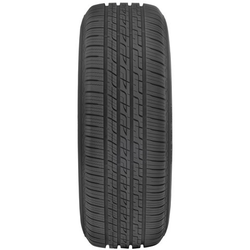
Proxes G-Tour | 265/65R17; 112; T; STANDARD LOAD; All Season
| Brand | Toyo |
|---|---|
| Type | Tire |
| Weight | 20.7 - 47 lbs |
| Approved Rim Width | 6" - 8", 6.5" - 8.5", 7.5" - 9.5", 7" - 8.5", 7" - 9", ... |
| Aspect Ratio | 55, 50, 45, 65, 60, ... |
| ATD Part Number | 124630, 113140, 113360, 113440, 113520.1, ... |
| Construction | Radial |
| Load Index | 104, 98, 110, 105, 102, ... |
| Load Range | EXTRA LOAD, STANDARD LOAD |
| Max Load | 1,984 lbs @ 50 psi, 2,039 lbs @ 50 psi, 2,337 lbs @ 50 psi, 1,653 lbs @ 50 psi, 1,521 lbs @ 51 psi, ... |
| Max Pressure | 50 psi, 51 psi, 44 psi |
| Mileage Warranty | 55,000 miles, 65,000 miles |
| Model | Proxes G-Tour |
| Overall Diameter | 29.1", 25.9", 27.3", 26.7", 26.3", ... |
| Ply | XL, SL |
| Rim Diameter | 18", 20", 17", 19", 16", ... |
| Season | All Season |
| Section Width | 235, 225, 245, 255, 275, ... |
| Segment | Passenger Tires, Light Truck / Passenger |
| Sidewall | Bw |
| Speed Rating | V, H, W, T |
| Temperature | A, B |
| Tire Size | LT245/75R16, 225/55R18, 235/50R19XL, 245/40R19XL, 245/65R17, ... |
| Traction | A |
| Tread Depth | 11.8/32", 11.7/32", 12.1/32", 11.6/32", 12.2/32", ... |
| Treadwear | 680, 600 |
| UTQG | 680 A A, 600 A A, 680 A B |
New arrivals, store-only specials and the occasional truck tip from our 22 locations across Alabama, Georgia, Mississippi and Florida.