Product description coming soon.
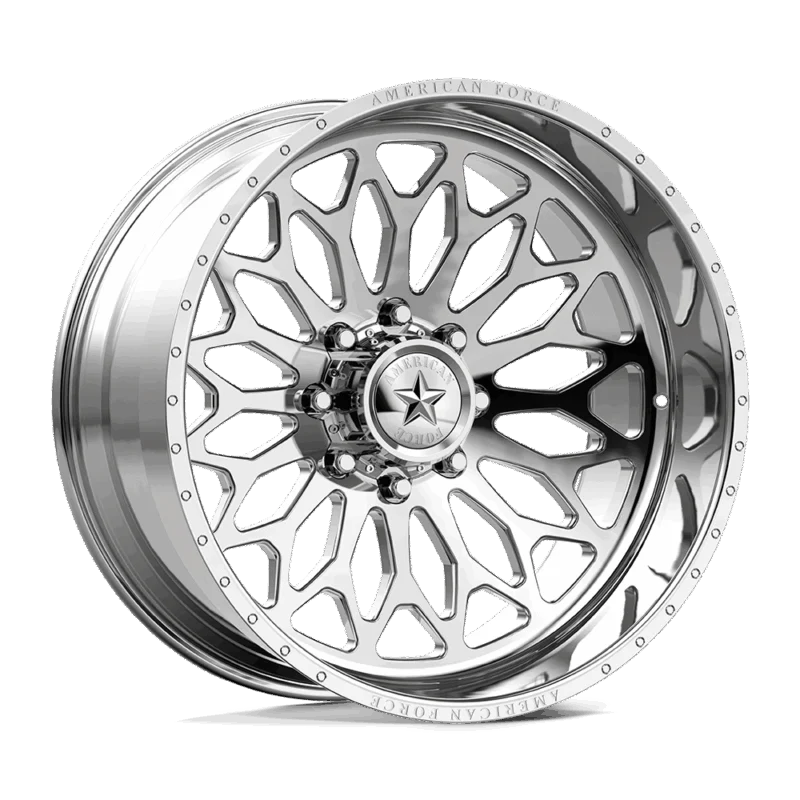
| Brand | American Force |
|---|---|
| Type | One-Piece |
| Weight | 52.5 lbs |
| Backspacing | 4.33" |
| Bolt Pattern | 8x170mm, 6x139.7mm (6X5.5), 8x180mm, 6x135mm |
| Center Bore | 78.1mm, 125mm, 87mm, 124mm |
| Center Cap Part No | AFX360A, AFX305A |
| Construction | Monoblock Forged |
| Cover Type | One-Piece |
| Diameter | 24", 22" |
| Finish | POLISHED |
| Finish Warranty | NO |
| Load Rating | 3500 lbs |
| Lug Count | 6, 8 |
| Offset | -55mm |
| Segment | On-Road |
| Structural Warranty | LIFETIME |
| Style | AFW CROOK CC |
| Style Number | CKH39 |
| TPMS Compatible | Yes |
| Wheel Weight | 48.5 lbs |
| Width | 12" |
6 wheels in this line. Start with the diameter, then narrow to the bolt pattern on your truck.
Both are stamped on the back of the wheel, behind the spokes. Enter them and every row below tells you how much further in or out it will sit.
Not sure what bolt pattern or offset your truck takes? Call your store and we will work it out for your truck — 888-865-4024
No 22" wheel matches that combination. Back off one filter above, or call 888-865-4024 and we will find the fit for your truck.
Wheel fitment depends on your suspension, tire size and how far you want them to sit out. We do not publish a fits-your-vehicle guarantee for this line — call 888-865-4024 before you order and we will confirm the bolt pattern and offset for your truck.
Diameter and bolt pattern are the easy part. Offset is the one that decides whether it rubs.
Offset is how far the mounting face — the flat pad that bolts to the hub — sits from the middle of the wheel, in millimeters.
Positive puts the face outboard of center, which pulls the wheel in under the fender. Factory truck wheels are usually positive.
Negative puts the face inboard, which pushes the wheel out. That is where stance comes from, and it is also where rubbing, wider track and more load on the wheel bearing come from.
A 30mm change in offset moves each wheel about 1.2" — the difference between clearing a fender and not. Use the Compare to what you run now box above the chart to see how far each row sits in or out against the wheels on the truck today.
They describe the same thing from opposite ends, and both are printed on every row above.
Offset is measured in millimeters from the wheel's centerline. Backspacing is measured in inches from the mounting face to the inside lip. Backspacing is the one that tells you whether the wheel will foul the brake caliper, the upper control arm or the steering knuckle.
Because backspacing counts from the inside edge, a wider wheel at the same offset gains backspacing. That is why swapping to a wider wheel and keeping the offset moves the tire inboard as well as out.
Written as the number of studs by the diameter of the circle they sit on: 6x139.7mm, the same circle also written 6x5.5". Both spellings mean one wheel.
On an even number of studs, measure center-to-center across from one to the one opposite. On five studs, measure from the center of one stud to the outside edge of the stud two along.
This one has no tolerance. A 6x135 wheel does not go on a 6x139.7 hub, however close the numbers look. If you are not certain, call 888-865-4024 with your year, make and model and we will confirm it before anything is ordered.
The center bore is the hole in the middle of the wheel. On a factory wheel it is machined to sit snugly over the hub, so the hub carries the weight and the studs only clamp — that is called hub-centric.
Aftermarket wheels are bored larger so one wheel fits many trucks. That leaves a gap, and the fix is a set of hub rings: plastic or alloy collars that take up the difference and re-center the wheel on the hub. Without them the wheel is centered by the lug seats alone, which is legal and works, but is the usual cause of a vibration that no amount of balancing will cure.
The hub bore for every wheel in this line is in the chart above. Tell us your truck when you call and we will include the right rings if it needs them.
Every truck sold in the US since 2008 has tire pressure sensors, and they live in the wheel. New wheels do not come with them.
Most of the time the sensors come out of the old wheels and go straight into the new ones, and the truck is told to relearn them. Sometimes a sensor is seized, corroded or already dead, and sometimes the wheel needs a different stem. That is a decision made with the wheels in front of us, not on a website.
Ask about it when you call — it is a normal part of the quote and it is better priced in than found later.
The wheel width sets the range of tire widths that will mount safely on it, and the wheel diameter has to match the tire's last number exactly — a 20" tire only goes on a 20" wheel.
Beyond that it is a judgment about your truck: how tall you can go before it rubs, how far out the offset puts them, and whether the suspension has been touched. We sell the tires as well as the wheels, so ask for both together and we will quote a set that we know works.
Call 888-865-4024 and we will put the pair together.